
Event Tech · For organizers
RFID and Cashless Payments at Festivals: Is It Worth the Investment?
Evaluate RFID wristbands and cashless payment systems for your festival. Learn the real costs, revenue impact, and implementation steps to decide if going cashless is right for your event.
Going Cashless Could Boost Your Festival Revenue by 22% - But Only If You Get the Implementation Right
Introduction
Cashless payment systems have moved from bleeding-edge novelty to mainstream expectation. Festivals adopting RFID wristbands and tap-to-pay systems report 15–30% higher attendee spending, sub-two-second transaction times, and real-time data that was impossible with cash registers and tip jars. The festival cashless payments market hit $2.12 billion in 2024 and is projected to reach $9.89 billion by 2033.
But going cashless isn't just flipping a switch. Poor implementation - not enough top-up stations, no cash fallback, a confusing refund process - can turn a revenue booster into a PR nightmare. This guide breaks down how these systems actually work, what they cost, and when they make financial sense for your event.
Understanding How Cashless Systems Work at Festivals
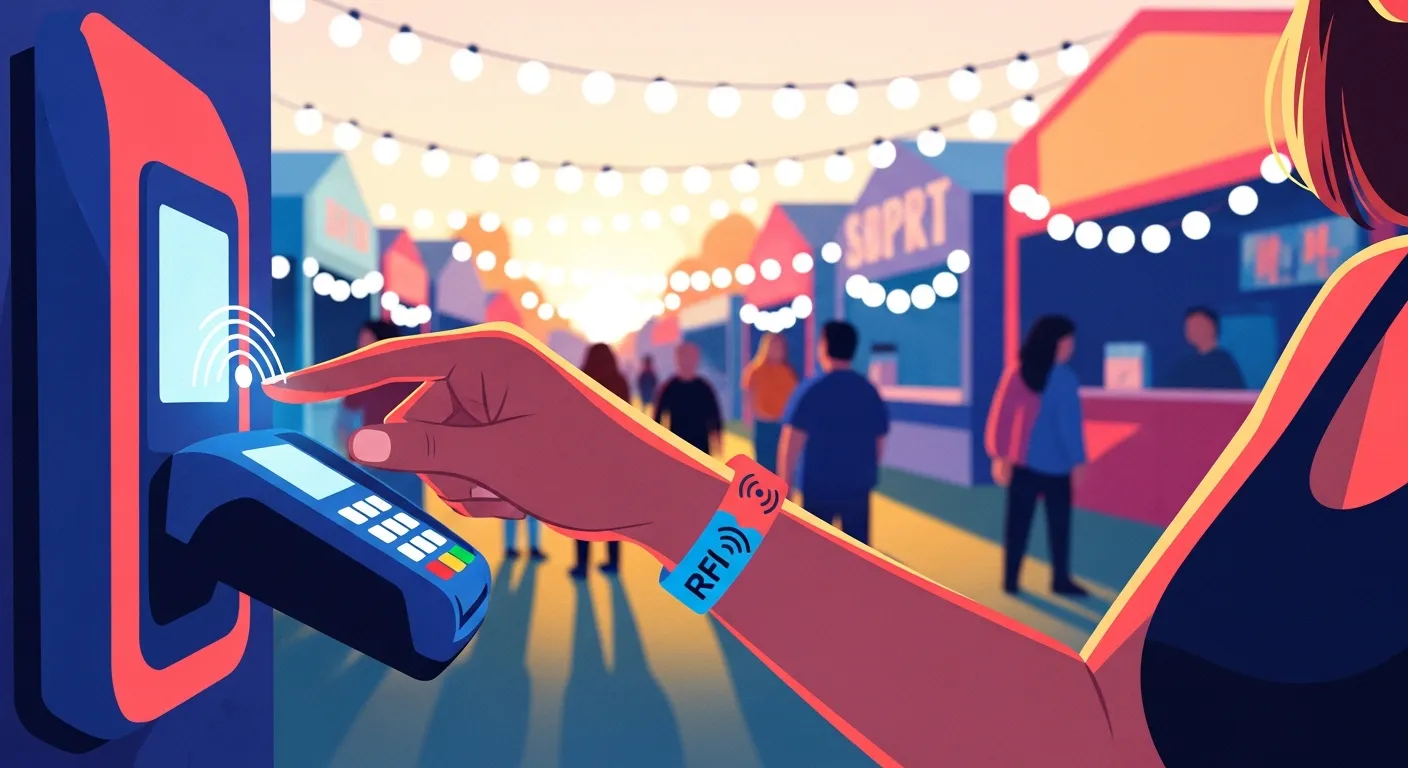
At its core, a festival cashless system replaces physical currency with a digital balance tied to an RFID wristband or NFC-enabled device. Attendees load funds before or during the event, then tap their wristband at vendor terminals to pay. Each transaction takes under two seconds and generates a timestamped data point - what was bought, where, when, and for how much.
There are two fundamental architectures. Closed-loop systems create a self-contained payment ecosystem: attendees load festival-specific credits that only work on-site. These process payments in under one second (even offline), give organizers complete data ownership, and are 53% faster than traditional card transactions according to American Express research. Open-loop systems accept standard credit and debit cards through conventional payment networks - familiar for attendees, but dependent on reliable internet connectivity and subject to higher processing fees.
Most experienced organizers land on a hybrid approach: closed-loop wristbands as the primary payment method with open-loop card terminals as backup. This gives you the speed and offline resilience of closed-loop with the accessibility of traditional payments.
Key Benefits That Drive the Business Case
Higher Spending Per Attendee
Festivals consistently report 15–30% increases in on-site spending after going cashless. Cocoon in the Park in Leeds saw a 39% revenue jump in just two years. The psychology is straightforward: when money is preloaded onto a wristband, spending feels like consuming already-committed resources rather than handing over cash. Festivals that offer bonus credits for advance top-ups ("load $100, get $110") amplify this effect further.
Dramatically Faster Transactions
A cash transaction takes 30+ seconds when you factor in counting, change-making, and verification. An RFID tap completes in under two seconds. That difference matters most during the 30-minute window between headliners when thousands of attendees rush concessions simultaneously. A vendor serving 20 cash customers per hour can serve 60+ with cashless - tripling throughput and capturing revenue that would otherwise be lost to abandoned queues.
Real-Time Operational Intelligence
Every cashless transaction feeds a live dashboard showing spending patterns, popular items, peak times, and bottleneck locations. If a food vendor is developing a 40-minute queue while the one across the path sits empty, you can redirect signage or staff in real time. After the event, multi-year transaction data informs vendor placement, F&B mix decisions, and performance timing - the kind of intelligence that was impossible when revenue data came from vendor self-reporting.
Reduced Theft and Shrinkage
Cash operations at festivals typically lose 1–3% of transaction volume to employee theft, customer theft, and accounting errors. Digital transactions create immutable audit trails that make theft difficult and detectable. Attendees benefit too - no cash to lose or have stolen in a crowd - which actually encourages them to load higher balances than they'd carry in their pockets.
6 Steps to Implement Cashless Payments
-
Choose your system architecture. Decide between closed-loop, open-loop, or hybrid based on your event size, connectivity reliability, and budget. Multi-day festivals with unreliable cell coverage should lean closed-loop. Single-day urban events may get by with open-loop card terminals alone.
-
Select a provider and negotiate terms. Major providers include Intellitix, Tappit, PlayPass, and CrowdBlink. Negotiate transaction fees (typically 1.5–5%), hardware rental vs. purchase, and data ownership. Get refund processing terms in writing before signing.
-
Plan your top-up station density. This is where most festivals fail. Place top-up stations at every entry point, near high-traffic vendor clusters, and at visible landmarks. The ratio should be roughly one station per 500–1,000 attendees. Cash-to-digital conversion stations are essential - not everyone has a credit card.
-
Train vendors and staff thoroughly. Allow 2–4 weeks for training. Every vendor needs to know how to process a transaction, troubleshoot a failed tap, and handle a system outage. Station 3–5 dedicated tech support staff across the grounds during the event.
-
Communicate with attendees early and often. Start messaging about the cashless system at least 4 weeks before the event. Explain how to pre-load funds, what happens at the gate, and how refunds work. Pre-event top-ups reduce gate congestion dramatically.
-
Build redundancy into everything. Have backup internet connectivity (a second provider or satellite uplink). Keep a small cash float at information booths for emergencies. Test offline transaction processing before gates open. The festivals that make headlines for cashless failures are the ones that assumed everything would work perfectly.
Common Questions About Going Cashless
-
What does it actually cost? For a 5,000-person event, expect $15,000–$40,000 all-in for wristbands, readers, software licensing, and network infrastructure. Larger festivals (50,000+) may invest $100,000–$500,000+ but benefit from dramatically better per-attendee economics. Most events achieve first-year payback through the spending increase alone.
-
What if attendees don't spend their full balance? Unspent balances ("breakage") can represent 5–15% of total loaded value. Some jurisdictions require you to hold these funds in trust. Build an easy refund portal - automatic refunds within 14 days are the industry best practice. A painful refund process generates more negative word-of-mouth than any other cashless issue.
-
Does cashless alienate older attendees or those without smartphones? Not if you plan for it. On-site cash-to-wristband conversion stations solve the accessibility issue. The wristband itself requires no smartphone to use - it's a tap. Pre-event communications should clearly explain that cash can be converted on-site.
-
What happens when the system goes down? This is the nightmare scenario, and it's happened - Reading Festival 2021 had network failures that stranded vendors. Closed-loop systems with offline processing are your insurance policy. Always have a documented fallback protocol, even if it's as simple as handwritten tallies with post-event reconciliation.
-
How do vendors get paid? Most systems settle digitally within 24–72 hours. Vendors see their transaction totals in real time and receive direct deposits after the event. This is actually faster and more reliable than the traditional envelope-of-cash approach - and most professional vendors prefer it.
Expert Tips for a Smooth Rollout
Start Hybrid, Then Optimize
Don't go 100% cashless in year one. Run a hybrid system where wristbands are the primary method but card terminals remain available. Track adoption rates, transaction volumes, and attendee feedback. Most festivals hit 85%+ wristband adoption by year two without forcing it.
Incentivize Pre-Event Top-Ups
Offer a 5–10% bonus credit for funds loaded before the event. This front-loads revenue, reduces gate congestion, and gives you a spending forecast before doors open. Festivals using this approach report that 60–70% of total funds are loaded before attendees even arrive.
Invest in Top-Up Station Placement
The number one operational complaint at cashless festivals is "I couldn't find a place to add money." Map your top-up stations the same way you'd map emergency exits - visible, frequent, and positioned along natural foot traffic paths. Use your site map to identify high-density zones and place stations accordingly.
The Cashless Festival Is Already Here
RFID and cashless payments aren't a future trend - they're the current standard for professionally run festivals. The question isn't whether to adopt cashless technology, but how to implement it in a way that maximizes revenue, minimizes friction, and keeps both attendees and vendors happy.
Start with a clear business case based on your event's size and economics. Plan for the edge cases - connectivity failures, cash-only attendees, refund processing. And treat year one as a learning investment, not a finished product. The data you collect in your first cashless season will be worth more than the system itself.
Running an event? List it on FestKit and take vendor applications for free. The site plan and live attendee maps are there when you want them. Start free.