
Festival Planning · For organizers
Festival Site Map Planning: The Complete Guide for Organizers
Learn how to plan an effective festival site map with actionable strategies for crowd flow, vendor placement, safety zones, and layout design.
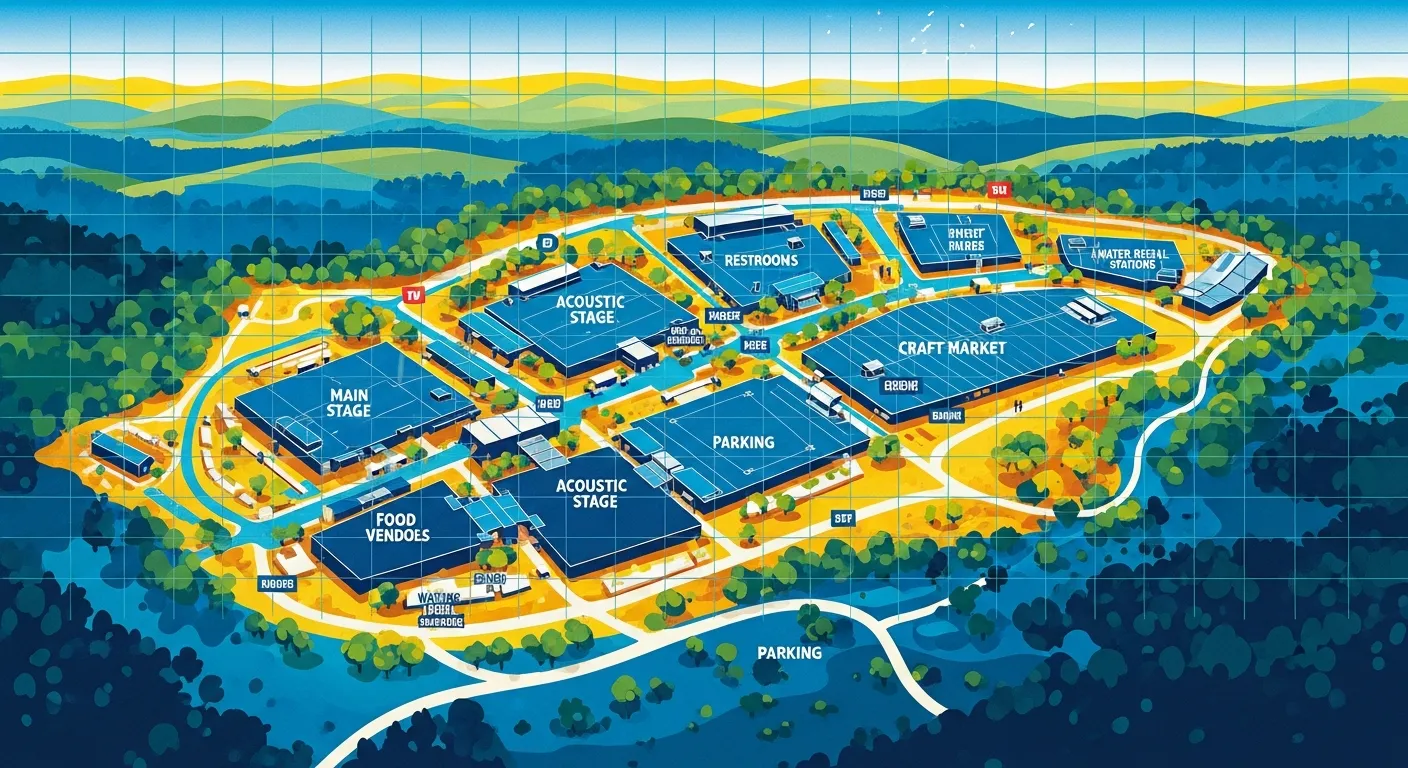
Your Festival Site Map Is the Blueprint for Every Attendee Experience
Introduction
A great festival isn't just about the lineup - it's about how people move through the space. The layout of your grounds determines whether attendees flow effortlessly between stages, discover vendors they didn't expect, and feel safe the entire time. Get it wrong, and you'll deal with bottlenecks at gates, dead zones nobody visits, and emergency access routes blocked by food trucks.
The good news: site map planning is a skill you can learn and improve with every event. This guide breaks down the strategies experienced organizers use to design festival layouts that work - for attendees, vendors, and operations teams alike.
Why Your Site Map Matters More Than You Think
Your site map isn't just a diagram you hand to the fire marshal. It's the single document that connects every operational decision: where power runs, how ambulances get in, which vendors get prime foot traffic, and how 10,000 people find the restrooms at 11 PM.
Poor site planning leads to real consequences. Bottlenecked entry points create crowd-crush risks. Vendors placed in dead zones lose revenue and won't return next year. Stages aimed at each other cause sound bleed that ruins both performances. Every one of these problems traces back to the map.
Modern organizers treat site mapping as a design discipline - one that blends crowd science, logistics, and attendee experience. The earlier you invest in your layout, the fewer fires you fight during the event.
Key Elements of an Effective Festival Layout
Crowd Flow and Circulation
The most common mistake is designing around stages, then hoping crowds figure out the rest. Instead, start with circulation paths. Main arteries should be wide enough to handle peak traffic (a general rule: 8-12 feet minimum for primary walkways at events over 5,000 capacity). Create natural loops that pull people through the site rather than forcing them to backtrack. Dead ends kill energy and create congestion.
Zoning by Function
Group related areas together: food and beverage vendors near seating, merchandise near stage exits, family areas away from late-night zones. This isn't just convenience - it simplifies power distribution, waste management, and staffing. Think of your site as neighborhoods, each with its own character and purpose.
Safety and Emergency Access
Every point on your site should be reachable by emergency vehicles within minutes. That means maintaining clear 16-foot-wide access lanes (the standard for fire apparatus) that stay unobstructed during the event. Place medical tents at central, visible locations - not hidden behind the main stage. Map your evacuation routes and make sure they lead somewhere safe, not into a parking lot bottleneck.
Sound and Sightlines
Orient stages so their sound projects away from each other and away from neighboring properties. Use natural terrain, structures, or even vendor rows as sound buffers between performance areas. Check sightlines from multiple vantage points - attendees in the back of a crowd shouldn't be staring at the back of a food tent.
7 Steps to Plan Your Festival Site Map
-
Walk the grounds in person. Satellite imagery and blueprints miss drainage issues, uneven terrain, and that tree line that blocks the only logical stage position. Walk it multiple times, in different weather if possible.
-
Map your infrastructure first. Before placing a single stage, identify every power source, water connection, existing road, and utility easement. Your layout must work around these fixed points - not the other way around.
-
Design entry and exit flow before anything else. Gates are your highest-risk chokepoints. Plan for separate entry and exit lanes, and consider staggered opening times for different ticket tiers to spread the initial rush.
-
Place anchor attractions to distribute crowds. Position your headliner stage and secondary stages at opposite ends of the site. This pulls crowds across the grounds and prevents everyone from clustering in one zone.
-
Assign vendor spots strategically. High-traffic intersections go to food vendors (people buy on impulse when walking). Quieter side paths work for artisan vendors who benefit from browse-friendly foot traffic. Give every vendor enough frontage to operate without blocking the walkway.
-
Build in buffer zones. Leave flexible open space between major zones. These buffers absorb unexpected crowd surges, give operations teams room to stage equipment, and provide natural "breathing room" that prevents the site from feeling cramped.
-
Test your map with a tabletop walkthrough. Before load-in day, gather your department leads and walk through the entire event timeline on the map. What happens when the headliner ends and 8,000 people head for the exits? Where does the beer garden line spill into? These scenarios reveal problems you can still fix on paper.
Common Challenges Organizers Face
-
How do I prevent bottlenecks at entry gates? Multiple entry lanes, bag-check stations offset from the gate, and pre-event communications about which entrance to use all help distribute the load.
-
What if my site has awkward terrain or an irregular shape? Use terrain to your advantage - hills become natural amphitheaters, tree lines become zone dividers. An irregular shape forces creative layout design that often produces a more interesting attendee experience.
-
How much space do I actually need per person? Industry standards suggest 15-20 square feet per person for standing festival areas, more for seated or family zones. Multiply your expected peak attendance by this figure to check if your site can handle it.
-
My vendors are complaining about their placement - how do I handle this? Transparent placement criteria solve most disputes. Share your foot-traffic data, explain why certain spots go to certain vendor types, and rotate premium spots across years to keep things fair.
-
What about accessibility for attendees with disabilities? ADA-compliant pathways need to be at least 36 inches wide with firm, stable surfaces. Accessible viewing areas at stages, accessible restrooms distributed across the site, and clear signage aren't optional - they're legal requirements and the right thing to do.
Expert Tips for a Better Site Map
Use Digital Mapping Tools Early
Paper sketches are fine for brainstorming, but switch to a digital mapping tool as soon as possible. Digital maps let you measure distances accurately, share with stakeholders in real time, and iterate without starting over. Tools built for festivals (like FestKit) let you draw zones, place vendors, and share interactive maps your whole team can access.
Plan for Weather - Not Just Good Weather
Rain turns grass paths into mud trenches. Wind changes sound projection. Heat creates demand for shade and water stations you didn't budget for. Design your layout with a contingency layer: where do you add extra matting if it rains? Which areas flood first? Where are your covered backup spaces?
Think Like an Attendee, Not an Organizer
Walk your map from the attendee's perspective. They don't have a radio or a site plan. Can they find food within 2 minutes of any point on the site? Can they see wayfinding signage from the main paths? Is there a logical "discovery flow" that rewards exploration? The best layouts feel intuitive even to first-time attendees.
Build Better Festivals, One Map at a Time
Your site map is where operational planning and attendee experience meet. It's the foundation that every other decision - from vendor contracts to security staffing to stage production - builds on. The time you invest in getting your layout right pays dividends in smoother operations, happier vendors, and attendees who actually want to come back.
Start with the fundamentals: walk your site, map your constraints, design for flow. Then refine with every event. Your best festival layout is always the next one.
Running an event? List it on FestKit and take vendor applications for free. The site plan and live attendee maps are there when you want them. Start free.