
Case Studies · For organizers
5 Festival Layout Mistakes That Cost Organizers Thousands
Avoid these common festival layout mistakes that drain revenue, frustrate vendors, and create safety risks. Learn what goes wrong and how to fix it.
These Layout Mistakes Are Silently Killing Your Festival's Revenue and Reputation
Introduction
You've booked the headliner, sold the tickets, and signed the vendors. But if your site layout has fundamental design flaws, none of that matters. The wrong layout decisions create bottlenecks that endanger attendees, dead zones that bankrupt vendors, and sound conflicts that ruin performances - problems that trace back to the map you drew months before gates opened.
The worst part? Most organizers don't realize these mistakes until they're standing in the middle of them. Here are five layout errors we see again and again, what they actually cost, and how to avoid them before your next event.
Why Layout Mistakes Are So Expensive
Festival layout errors compound fast. A single bottleneck at the entrance ripples into late arrivals, missed openers, and overwhelmed security staff pulling overtime. A poorly placed vendor row means lower sales and vendors who won't return next year.
Festivals with well-designed layouts see 35–40% higher ticket renewal rates. Vendors in high-traffic zones report sales increases of up to 50% over those stuck in dead zones. And the safety stakes are even higher: inadequate entry design and overcrowded stage areas have contributed to some of the worst crowd incidents in event history.
The 5 Mistakes (and What They Cost)
Mistake 1: The Single Entry Funnel
One gate, one line, one massive problem. Organizers who route all attendees through a single entry point create a forced bottleneck that's both a safety hazard and an experience killer.
The math is unforgiving: a 3-meter gate can process roughly 250 people per minute under ideal conditions. Factor in bag checks and ticket scanning, and real throughput drops closer to 70 per minute. If 5,000 attendees arrive in a one-hour window, you're looking at wait times exceeding 45 minutes - and a growing, agitated crowd with nowhere to go.
Single entry points also create dangerous crowd pressure. When people perceive only one way in, pushing increases and crush risk escalates. The 2010 Love Parade disaster in Duisburg was directly traced to a single-tunnel access point that became a fatal bottleneck.
The fix: Design multiple entry points distributed across your site. Stagger opening times for different ticket tiers. Separate bag-check lanes from express entry. Calculate gate throughput against your expected arrival curve - not just total attendance.
Mistake 2: Stages That Fight Each Other
Two stages pointed at each other 200 meters apart might look efficient on a site map. In reality, it's a recipe for sound bleed that ruins both performances simultaneously.
Low-frequency bass travels further and penetrates barriers more effectively than higher frequencies. Without adequate separation, the kick drum from Stage B bleeds directly into the acoustic set on Stage A. Sound engineers scramble to compensate by pushing volume (making the problem worse), and attendees in between get an unlistenable collision.
Artists and their management notice when a festival can't deliver clean sound - that reputation affects your ability to book talent in future years.
The fix: Orient stages so sound projects in the same direction or away from each other. Use terrain, structures, and vendor rows as natural sound buffers. Industry best practice recommends 300 meters minimum between facing stages, or 150 meters with a 90-degree offset. Schedule complementary genres on adjacent stages - heavy bass on one, acoustic-friendly or a break on the other.
Mistake 3: No Emergency Vehicle Access
A medical emergency at the far end of your site, and the ambulance can't get through because vendor trucks are parked across the access lane. It happens more often than you'd think.
Fire codes require 16-foot-wide unobstructed access lanes. But during load-in, these lanes get treated as overflow parking, storage, and vendor staging zones. By gates-open, your "clear" route is a maze of coolers, generators, and tent stakes.
The cost isn't just a citation from the fire marshal. Every minute of delay reaching a medical emergency changes outcomes. Liability assessments consistently flag inadequate emergency access as a primary factor in lawsuits following festival injuries.
The fix: Mark emergency routes on your site map in a color that screams "do not touch." Brief every vendor and crew member during load-in. Walk access routes 30 minutes before gates open and enforce clearance. Use removable bollards that prevent accidental obstruction while letting emergency vehicles through.
Mistake 4: Restrooms in No-Man's Land
Placing all your portable restrooms in a distant corner seems logical - keep the smell away. But when attendees walk 10 minutes to find a restroom, they either hold it until it's urgent (creating surges that overwhelm facilities) or find "creative alternatives" across your site.
Industry standards recommend one unit per 50–75 attendees for events serving alcohol, distributed so no one walks more than 2–3 minutes. Clustering all units in one spot violates both halves of this standard.
The hidden cost: restroom complaints are the number-one driver of negative post-event reviews. Attendees forgive a delayed set time. They won't forgive a 20-minute walk and a 30-minute line.
The fix: Distribute restroom clusters near food areas, between stages, and at entry/exit points. Place premium units near VIP and family zones. Add clear wayfinding signage. Budget for 15% more units than the minimum - the standard assumes even usage throughout the day, which never happens.
Mistake 5: The Dead Zone That Kills Vendor Revenue
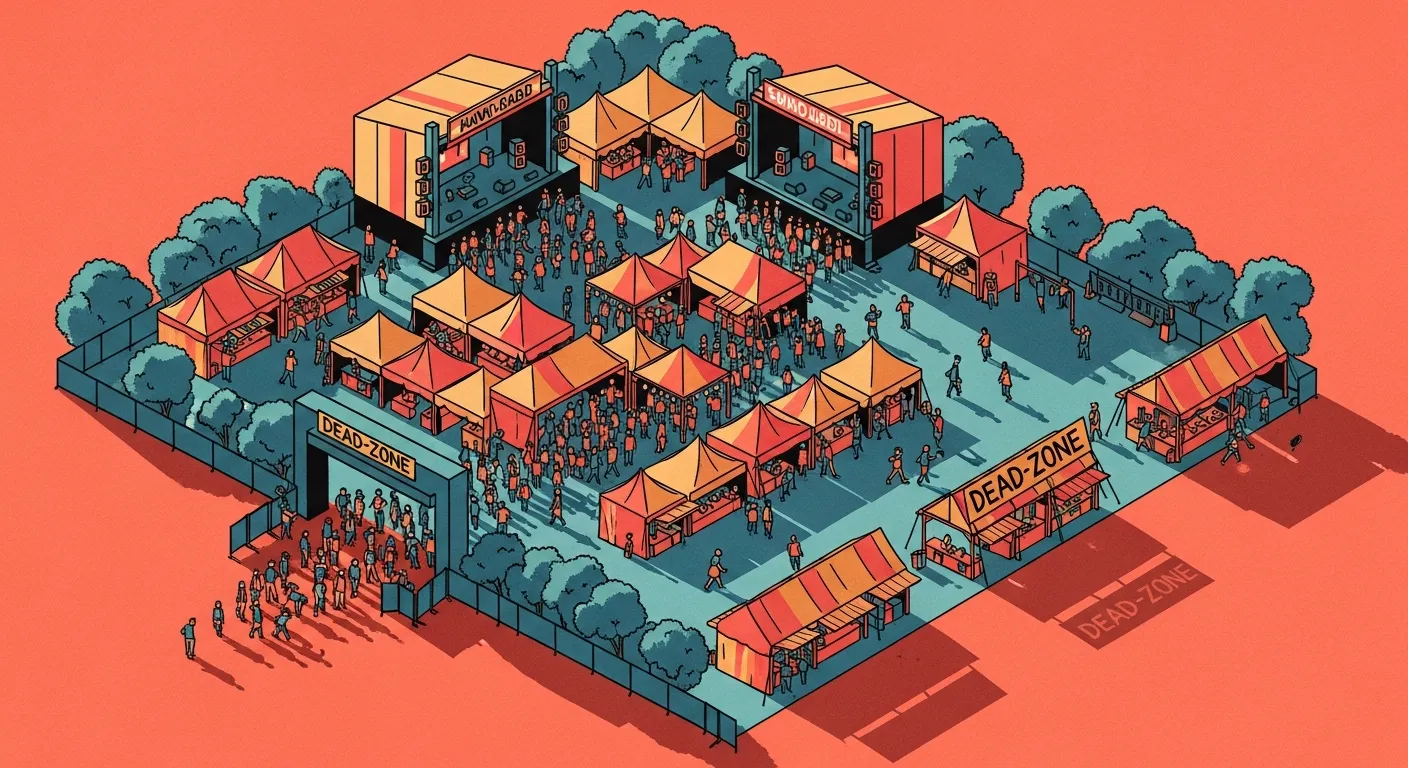
Every festival has that one corner of the site where foot traffic drops to nearly zero. Maybe it's behind a stage, down a dead-end path, or in a section that attendees have no reason to walk through. Place vendors there, and you've essentially guaranteed they'll lose money.
One traffic study at a California music festival found their vendor area received only 15–20% of total foot traffic despite occupying 25% of the venue footprint. After relocating vendor rows to intersect with high-traffic corridors between stages and the food court, per-booth sales jumped 52%.
Vendors talk to each other. One bad placement doesn't just cost you that vendor - it costs you their entire network who hear "don't bother with that festival."
The fix: Map expected foot traffic before assigning vendor spots. Place food vendors at high-traffic intersections. Position artisan vendors along connector paths between anchor attractions. Eliminate dead ends - every path should loop back to a main artery. If an area will have low traffic, don't sell it as vendor space - use it for operations or rest areas.
Common Questions About Festival Layout
-
How wide should main walkways be? Primary pathways need 8–12 feet minimum for events over 5,000 capacity. Near stages and entry points, 16–20 feet handles surge traffic safely.
-
What's the right number of entry gates? At least one entry lane per 1,000 expected attendees in your peak arrival hour. More gates with slower throughput beats fewer gates with higher throughput.
-
How do I know if an area will be a dead zone? Walk the site as an attendee. If a path doesn't lead to or from something people want, they won't use it.
-
Should I share foot traffic data with vendors? Yes. Transparent placement criteria reduce disputes and help vendors choose the right spot for their business type.
-
What about accessibility? ADA-compliant pathways (minimum 36 inches, firm surface) should be integrated into every primary route, not treated as a separate concern.
Tips for Getting Your Layout Right
Start With Circulation, Not Attractions
Most organizers place stages first and figure out paths later. Flip that. Design your circulation network - entry points, main arteries, connector paths, and exit routes - before placing a single stage or vendor zone. Attractions should plug into the flow, not define it.
Use Digital Tools to Test Before You Build
Paper sketches can't calculate distances or model crowd flow. Digital mapping tools let you iterate quickly, measure walking distances, and catch problems at scale. When your whole team can see and annotate the same map, layout errors get caught in planning - not on event day.
Do a Tabletop Walkthrough With Your Team
Before load-in, walk through the entire event timeline on your site map with department leads. What happens when the headliner ends and 8,000 people head for exits? Where does the beer garden line spill? These scenarios reveal problems you can still fix on paper.
Your Layout Is Your Festival's Operating System
Every operational decision - from vendor contracts to security staffing to medical response planning - builds on top of your site layout. The five mistakes above aren't rare edge cases. They happen at festivals of every size, every year, and they're almost always preventable with better planning.
The organizers who invest time in their layout before the event don't just run smoother operations. They build festivals that vendors want to return to, attendees recommend to friends, and teams feel proud of. That's the real return on getting your map right.
Running an event? List it on FestKit and take vendor applications for free. The site plan and live attendee maps are there when you want them. Start free.