
Event Tech · For organizers
Festival Communication Systems: Keeping Your Team Connected On-Site
Build a reliable festival communication system with two-way radios, channel planning, and backup protocols that keep your team coordinated when cell networks fail.
Your Festival Communication System Can Make or Break Event Day
Introduction
It's 9 PM on the main stage, the headliner just started, and your security lead can't reach the medical team. Texts aren't sending. Calls go straight to voicemail. Ten thousand attendees just overwhelmed the nearest cell tower, and your team is running blind across 40 acres of festival grounds.
This scenario plays out at events every season - and it's entirely preventable. A reliable festival communication system isn't optional infrastructure. It's the backbone of every operational decision your team makes in real time. This guide covers how to build a communication setup that works when your cell phone won't, from radio channel planning to emergency escalation protocols.
Why Cell Networks Fail at Festivals
Most local cell towers are engineered for roughly 5,000 simultaneous users. Drop 15,000 to 50,000 attendees into a concentrated area, and those towers hit capacity within the first hour. Calls fail, texts queue for minutes, and data crawls to a halt. Your team's group chat becomes useless precisely when you need it most.
This isn't a theoretical risk. At one remote beach festival, an overloaded cell network left security unable to call for backup during altercations - staff had to physically sprint across the grounds to relay messages. Medical response times doubled. The 2010 Love Parade disaster exposed the same vulnerability: jammed cell networks meant no one could coordinate crowd management when it mattered most. Relying on cell phones as your primary communication system is planning to fail.
Key Elements of a Reliable Communication System
Two-Way Radios as Your Foundation
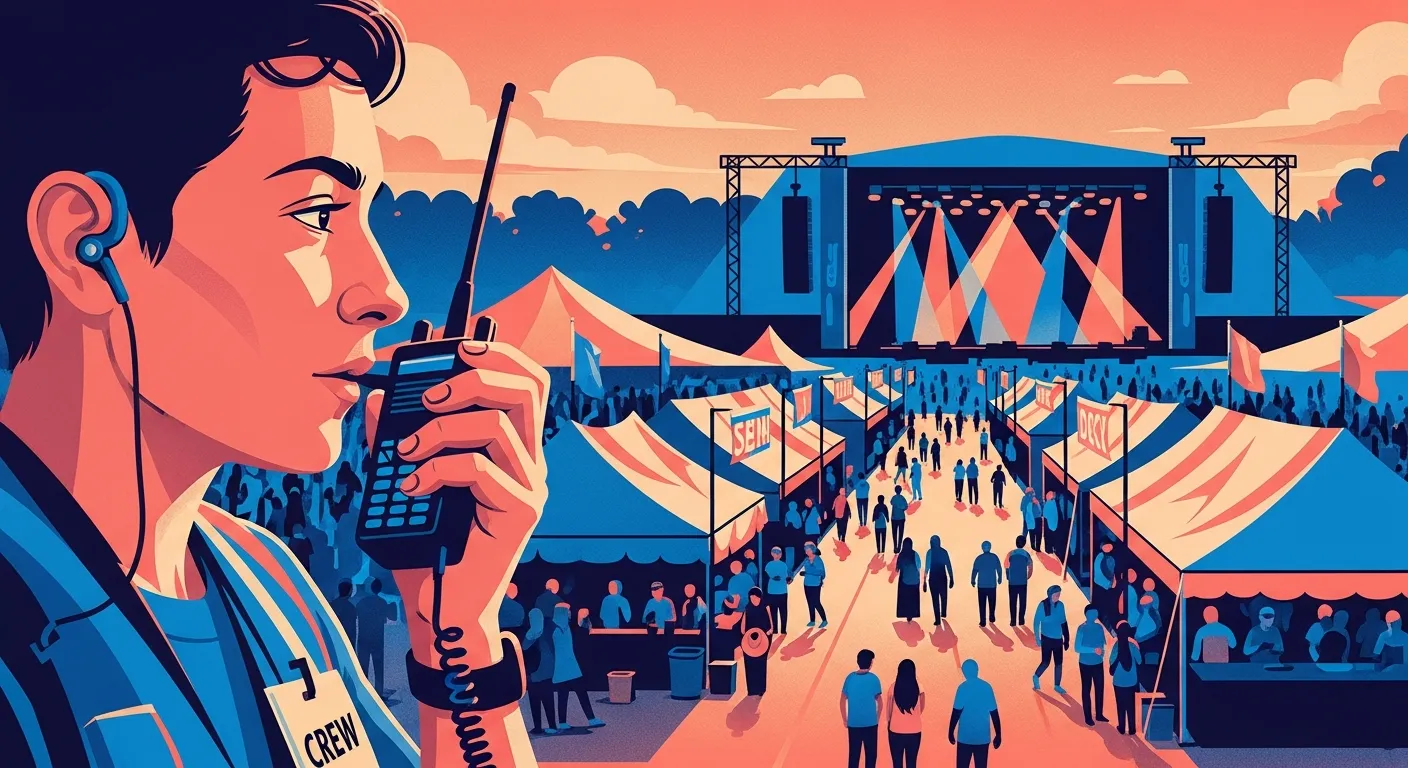
UHF two-way radios remain the most reliable communication tool for festival operations. They work independently of cell infrastructure, provide instant push-to-talk access, and cover large outdoor areas when paired with the right equipment. For compact sites under 10 acres, basic handheld UHF radios handle the job. For larger grounds with terrain obstacles, you'll need repeaters or a trunked radio system to maintain coverage across every zone.
Structured Channel Planning
A channel plan prevents departments from talking over each other during critical moments. Assign dedicated channels for each operational area: security, medical, production, vendor operations, gates and parking, and a command channel reserved for leadership. Keep one emergency-only channel clear at all times - it's the channel everyone monitors but no one uses unless there's a genuine crisis.
Communication Hierarchy
Not everyone needs to talk to everyone. Define a clear hierarchy: zone leads communicate within their teams on department channels, escalate issues to the operations center on the command channel, and the event director coordinates across departments. This structure prevents radio chatter from drowning out urgent calls. Every team member should know exactly who to contact and on which channel before gates open.
Earpiece Headsets for Noisy Environments
Festival noise levels make it nearly impossible to hear a handheld radio speaker near stages or large crowds. Equip every radio with an earpiece headset so staff can hear transmissions clearly without holding a radio to their ear. Earpieces also keep security communications discreet - critical when handling sensitive situations in public view.
7 Steps to Build Your Festival Communication Plan
-
Map your communication zones. Divide your site into zones that match your radio channel plan. Use your site map to define boundaries - main stage area, vendor rows, camping, parking, VIP, and back-of-house. Each zone gets a designated channel and zone lead.
-
Choose the right radio equipment. Match your hardware to your site. UHF handhelds work for most festivals. Add repeaters if your grounds exceed 20 acres or have significant terrain. Budget for 10-15% extra radios as spares - batteries die and equipment gets dropped.
-
Create a channel assignment chart. Document every channel assignment in a single-page reference card that fits in a lanyard pocket. Include channel numbers, department names, and zone lead names. Print enough for every radio holder plus extras for day-of additions.
-
Establish radio etiquette protocols. Train your team on standard call procedures: identify yourself and the recipient before speaking, keep transmissions under 10 seconds, wait for acknowledgment before continuing, and never use codes or jargon that volunteers won't understand. Plain language saves lives.
-
Set up your command post. Designate a central operations hub with a base station radio monitoring all channels, a whiteboard tracking active incidents, and a landline or satellite phone as a backup link to emergency services. This is your nerve center - staff it with your most experienced operators.
-
Run a pre-event communications briefing. Every radio holder gets a 15-minute briefing covering their channel assignment, escalation procedures, emergency protocols, and a live radio check. Do this the morning of the event, not the night before. People forget overnight.
-
Test coverage before gates open. Send team members to the far corners and dead zones of your site for a full radio check. Identify weak spots and reposition repeaters or assign runners for areas with poor coverage. This takes 30 minutes and prevents hours of frustration.
Common Questions Organizers Ask
-
How many radios do I need? Plan one radio per zone lead, department head, and key volunteer coordinator - plus 10-15% spares. A 200-person staff festival typically needs 30-50 radios.
-
Should I rent or buy radios? For one-off events, rental is cost-effective and includes technical support. If you run three or more events per year, owning your fleet pays for itself and lets you standardize training.
-
Can push-to-talk apps replace radios? Apps like Zello work as a supplement, but they depend on Wi-Fi or cell data - exactly the infrastructure that fails at large events. Use them for non-critical pre-event coordination, never as your primary system during the live show.
-
What about digital radios vs. analog? Digital (DMR) radios offer clearer audio, better range, and built-in encryption for security channels. They cost more upfront but the audio quality difference in noisy festival environments justifies the investment for events over 5,000 capacity.
-
How do I handle communication with contractors and third-party vendors? Issue loaner radios to critical contractors (stage production, power, catering leads) on their own channel. Include radio return in your load-out checklist - equipment walks away fast after a long festival weekend.
Expert Tips for Festival Communications
Integrate Channels With Your Site Map
Label your site map zones to match your radio channel assignments. When someone calls in "medical emergency in Zone 3," every team member can glance at the map and know exactly where to go. Use landmarks as reference points in radio calls - "north side of the main stage" is faster to locate than GPS coordinates.
Build Redundancy Into Every Layer
Never rely on a single communication method. Your primary system should be two-way radios, backed up by a secondary method like satellite phones or mesh network devices for key leadership. Keep analog fallbacks ready: whistles for crowd safety staff, physical runners for short-distance urgent messages, and pre-printed emergency procedure cards that don't need a signal to work.
Plan for Equipment Failures
Batteries die at the worst moments. Set up a radio charging station at your command post and require zone leads to swap batteries at the halfway point of each shift. Keep a log of which radio is assigned to whom - when something goes wrong, you need to know who had which radio. Waterproof bags protect equipment during rain, and lanyards prevent drops in crowds.
Build Communication Confidence Before Event Day
A festival communication system doesn't need to be expensive or complex - it needs to be reliable, tested, and understood by every person holding a radio. The difference between a smooth event and operational chaos often comes down to whether your team can reach each other in the first 30 seconds of an incident.
Start with your site map, build your channel plan around your zones, brief your team the morning of, and always have a backup for your backup. When your communication system works, everything else gets easier - from routine vendor check-ins to coordinating an emergency response across 40 acres.
Running an event? List it on FestKit and take vendor applications for free. The site plan and live attendee maps are there when you want them. Start free.